Dave is a marketing expert with 15 years experience in the tech and SaaS world. He specializes in educating IT and channel audiences, with a focus on security, privacy, compliance, and marketing technology. With a talent for storytelling and a deep understanding of the industry, Dave transforms complex IT topics into clear, engaging, and impactful narratives.
Email disclaimer laws and requirements: What applies in the US, UK, EU, and Canada
TL;DR
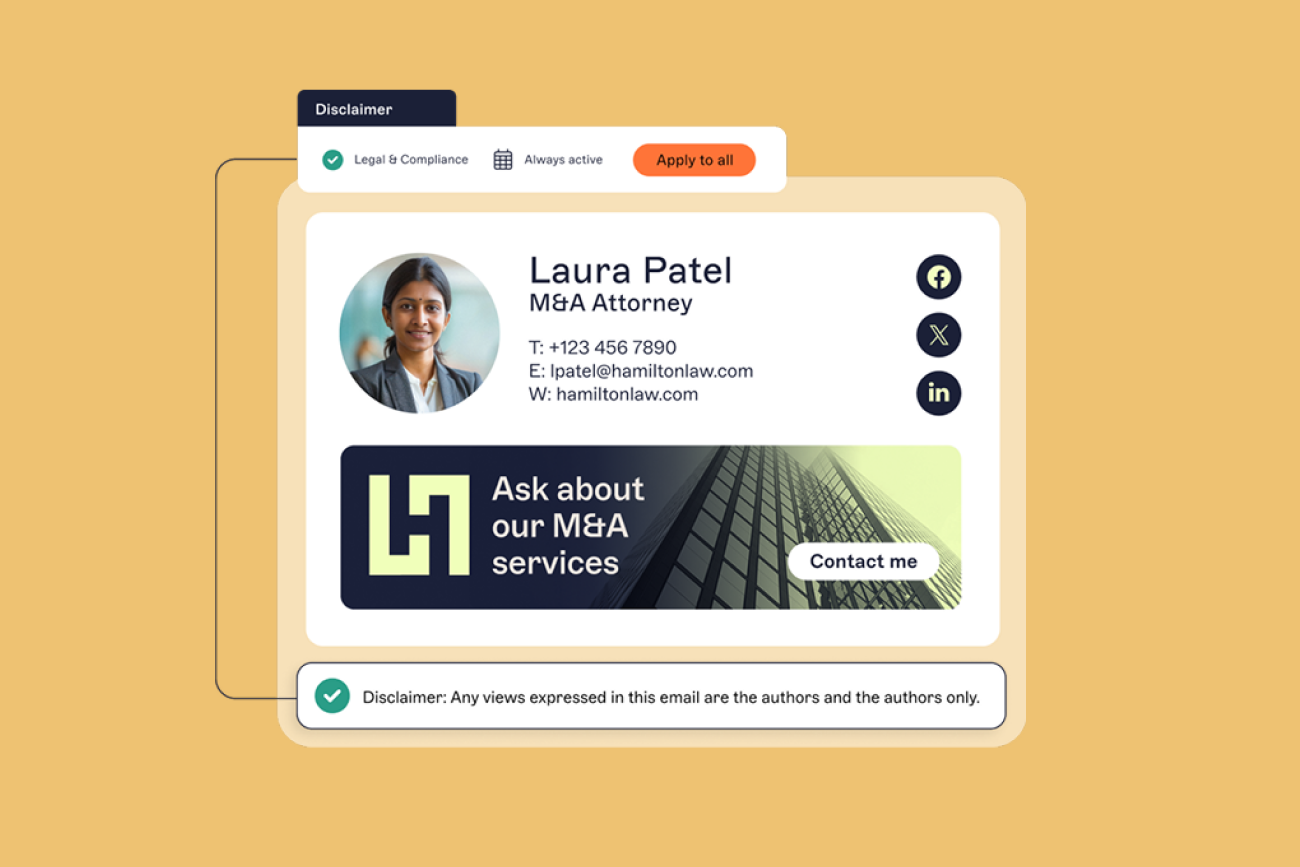
No general law in the US, UK, EU, or Canada requires a disclaimer on every business email.
UK companies must put their registered name, place of registration, registered number, and registered office address on business letters, including electronic ones. EU member states set similar rules in national law.
The penalties are low on paper: up to £1,000 plus a daily fine in the UK, and up to €5,000 per order in Germany.
Commercial email has separate rules in the US and Canada, and healthcare and financial services firms face sector rules on top.
Is an email disclaimer required by law?
 No law in the four jurisdictions covered here requires a general confidentiality or liability disclaimer on every business email. What the law does require is a short list of company details on business correspondence and sender identification on commercial email, plus a few sector rules.
A disclaimer is a convenient place to carry required company details, and our email disclaimer examples and templates show how organizations word one. That guide also covers the healthcare and financial services rules that sit on top of these. The company-details rules specify what must appear and don't prescribe wording. Requirements depend on company type and sector, so check yours with counsel before you change a footer.
Jurisdiction | What the law requires on business email | General disclaimer required? | Read more |
|---|---|---|---|
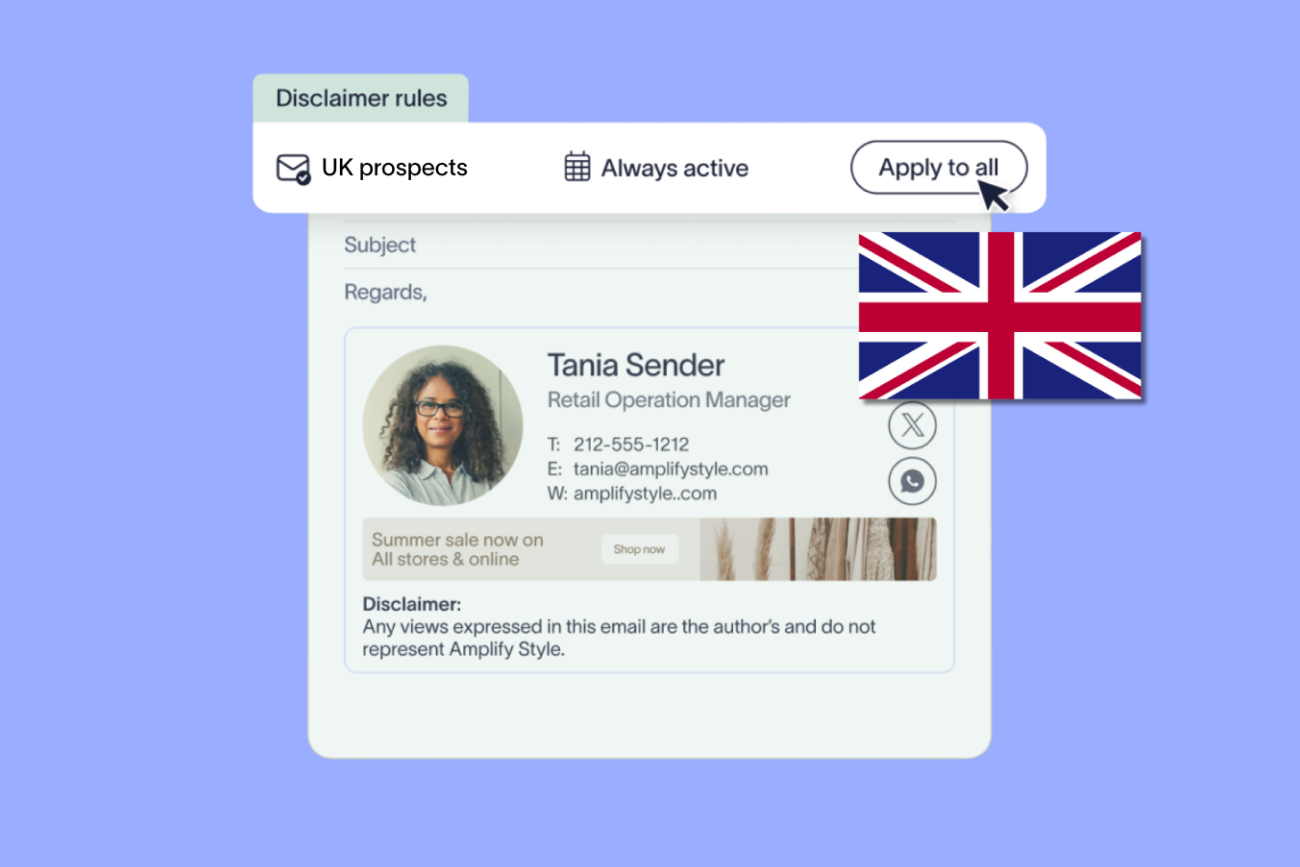
UK | Registered name, place of registration, registered number, and registered office address on business letters and order forms, in hard copy or electronic form. | No | Email disclaimers in the UK |
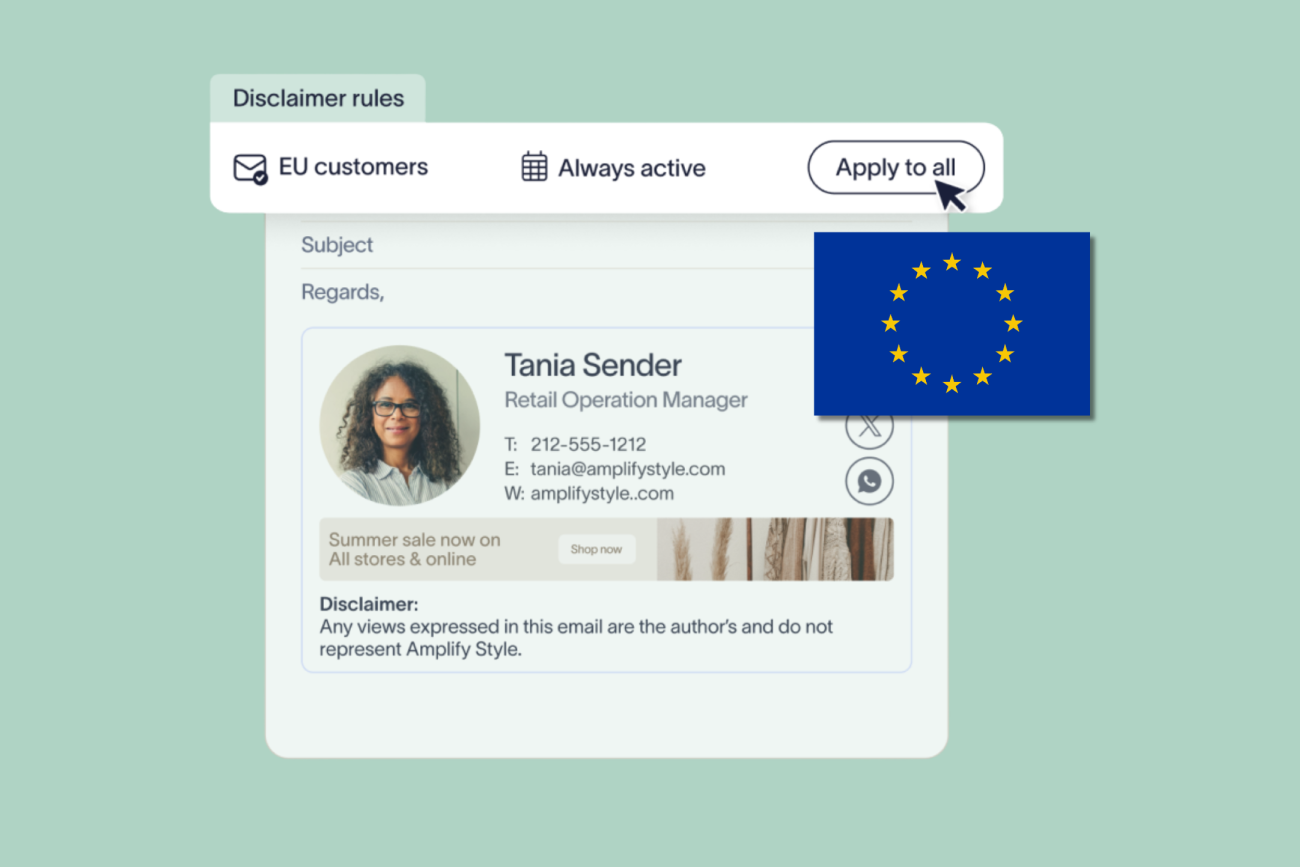
EU | Company particulars on letters and order forms in any medium under Article 26 of Directive (EU) 2017/1132, applied through national law. | No | Email disclaimers in the EU |
US | No federal or state rule for a general disclaimer. Commercial email must identify the sender, include a postal address, and offer an opt-out. | No | U.S. email disclaimers |
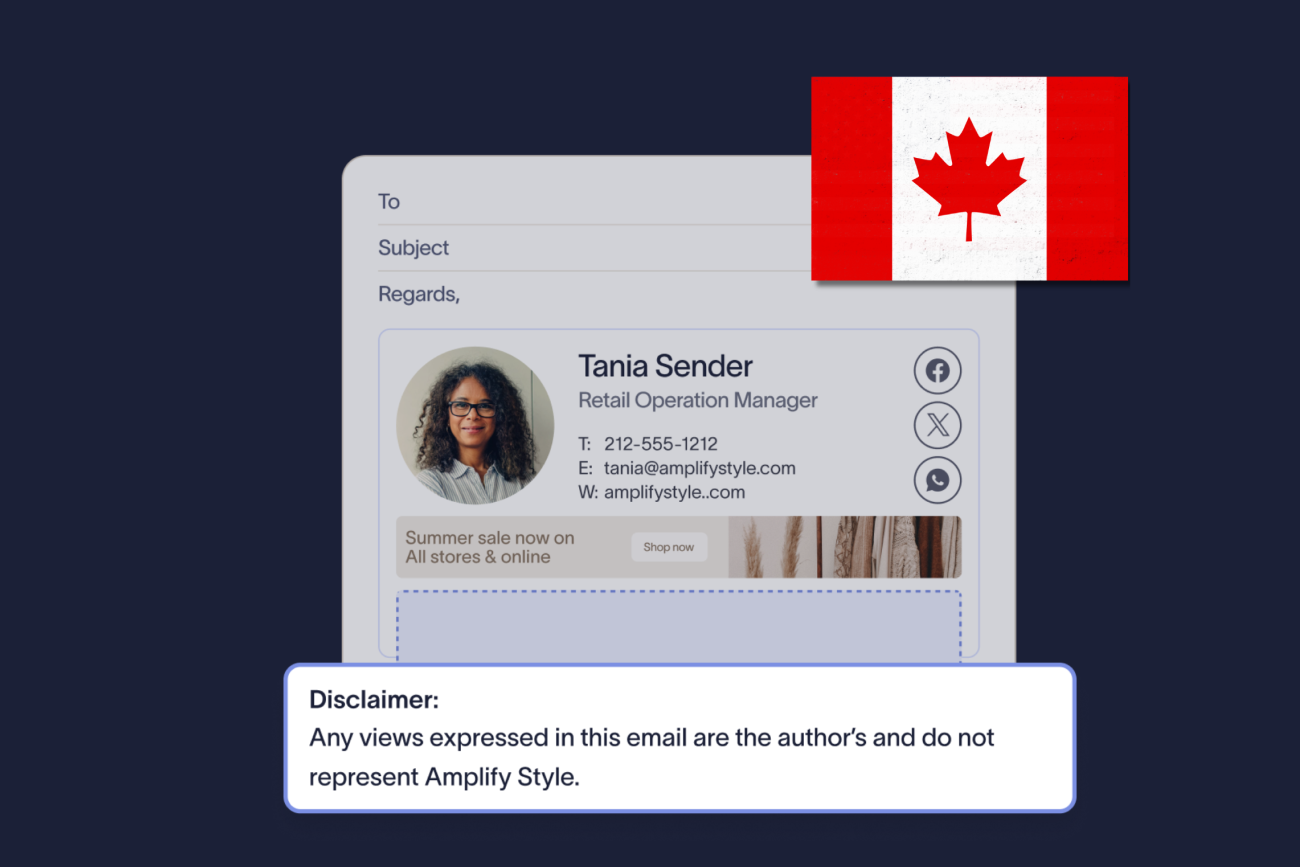
Canada | Commercial electronic messages need consent, sender identification, and an unsubscribe mechanism. | No | Email disclaimers in Canada |
“Disclaimers are part of the broader compliance toolkit, alongside encryption, DLP and retention policies. They don't replace those, they show intent. When regulators audit your communications, they're not just checking you secured the data, they're looking at what you told people about it.”
What does UK law require on business email?

The 2015 Regulations
UK limited companies and limited liability partnerships have to disclose company details on business correspondence. The rules sit in Part 6 of the Company, Limited Liability Partnership and Business (Names and Trading Disclosures) Regulations 2015. The Companies (Trading Disclosures) Regulations 2008 were revoked when these took effect on January 31, 2015.
Regulation 24 requires a company's registered name on its business letters and on "all other forms of its business correspondence and documentation." Regulation 25 adds three particulars to business letters, order forms, and websites:
the part of the UK where the company is registered
the company's registered number
the address of its registered office
A few conditional particulars apply, such as the fact that a company exempt from using "limited" in its name is a limited company. Regulation 29 treats a document in electronic form the same as one in hard copy.
Do the UK rules cover email?
Tip
Trading Standards guidance from Pembrokeshire County Council lists business emails among the communications that must carry the registered name. Whether an email also counts as a business letter, which triggers the other particulars, is for counsel. Put all the details in the footer of every business email and the question goes away.
A footer that carries the registered name and all three particulars looks like this:
Example Trading Limited. Registered in England and Wales, number 00000000. Registered office: 1 Example Street, London XX1 1XX.
What does EU law require on business email?
The company law directive
Article 26 of Directive (EU) 2017/1132 tells member states to require that letters and order forms, in paper form or any other medium, carry certain company details:
the register and company number
the legal form
the registered office
where it applies, the fact that the company is being wound up
A company that mentions its capital has to give the subscribed and paid-up figure. Company websites carry the same particulars.
National rules in Germany and Austria
The directive sets the baseline, and each member state writes its own rule, so the exact particulars and penalties vary by country. Germany has applied the duty to business letters of any form addressed to a specific recipient since January 1, 2007 (section 37a of the Handelsgesetzbuch). The list depends on the company's legal form. Guidance from the Osnabrueck chamber of commerce treats email as covered.
The Austrian Economic Chamber addresses email signatures directly. It notes that they typically carry only the sender's email address and phone number. It states that businesses in the commercial register must show their statutory details on email.
Does the directive cover email?
The directive says "any other medium" and doesn't name email. German and Austrian guidance treats business email as covered, and the UK regulations count electronic documents. Our review covered only Germany and Austria among EU member states, so check local guidance for the rest. The EU guide linked above has country-by-country examples.
Tip
Tailor the language of your disclaimer depending on jurisdiction, industry, and audience. Use personalization (like sender name or department) where required by law.
"Email disclaimers can be an underrated area. They look small, and we're all so used to seeing them at the bottom of a message, but they carry mandated information in a number of jurisdictions and industries, and that information is often determined by regulatory requirements. Not having them, or not being able to show you had them on particular communications, can cause you an evidence problem."

What does US law require on business email?
 No federal or state law in the United States requires a general email disclaimer. The Controlling the Assault of Non-Solicited Pornography and Marketing Act, known as the CAN-SPAM Act, covers commercial email. Senders must identify themselves accurately and give a physical postal address, and recipients need a working way to opt out. A confidentiality-style disclaimer isn't part of the requirements.
The U.S. guide linked above covers the other federal and state rules that touch email.
Tip
Keep disclaimers short, readable, and relevant. Use legal review to confirm jurisdictional accuracy and avoid unnecessary risks.
What does Canadian law require on business email?
Canada's Anti-Spam Legislation, known as CASL, governs commercial electronic messages. Senders need the recipient's prior consent, express or implied, and each message must identify the sender and give contact information. It must also include a working unsubscribe mechanism. Innovation, Science and Economic Development Canada specifies that the contact details must include a current mailing address plus a phone number, email address, or website address. They must stay valid for at least 60 days after sending.
The Canada guide linked above covers the privacy laws.
Simplify email disclaimer creation
Skip the guesswork and create a clear, usable email disclaimer in minutes with Exclaimer’s generator.
What are the penalties for leaving company details out of an email?
The figures below are maximums set in law.
Country | What a company can face |
|---|---|
UK | A fine of up to £1,000 (level 3 on the standard scale), plus a daily default fine of up to one-tenth of that for continued breach. The offence applies where a company fails, without reasonable excuse, to comply, and the company and every officer in default can be liable (regulation 28). |
Germany | A register court can order coercive penalties of up to €5,000 per order (section 14 of the Handelsgesetzbuch). German commentary also discusses competitor warning letters under unfair competition law, and sources disagree on whether they succeed. |
Austria | The commercial register court can impose coercive penalties of up to €3,600, with further penalties if the order is ignored. |
US | Up to $53,088 per email for violating the CAN-SPAM Act, as adjusted by a Federal Trade Commission (FTC) rule effective January 17, 2025. The FTC announced no adjustment for 2026. |
In August 2024 the FTC described its $2.95 million settlement with Verkada as the largest CAN-SPAM penalty it had obtained. The penalty was solely for commercial email with no working unsubscribe, ignored opt-outs, and no physical postal address.
Do AI-generated emails need a disclaimer?
Using AI to draft an email doesn't remove any disclosure the email already needed. Ed Bodey, Exclaimer's General Counsel, says mandatory disclosures and disclaimers "still apply even where AI is doing the writing." He adds that company identification and industry disclosures don't go away "just because a machine wrote the message."
Article 50 of the EU AI Act has applied since August 2, 2026. Its machine-readable marking duty falls on the providers of generative AI systems. Regulation (EU) 2026/1744 gives systems already on the market until December 2, 2026 to meet it. Nothing we found settles whether an employee who drafts an email with an AI tool, then reviews and sends it, falls under the article. The examples and templates guide linked earlier covers the rest of Article 50 and AI disclaimer wording.
"Mandatory disclosures and disclaimers still apply even where AI is doing the writing... company identification, industry disclosures, none of that goes away just because a machine wrote the message."
Across a 2,000-person UK and US study Exclaimer ran in mid-2026, 41% of people said they'd questioned whether a message they received was genuine, and 48% said the channel a message arrives on affects how trustworthy it feels. An email that looks and reads like every other email from your organization, disclaimer included, is one less reason for a recipient to wonder.
“When I look at phishing emails, a lot of them don't have proper disclaimers, so a well-worded disclaimer can be one of the first things you check to judge whether a message is legitimate. You can spot the AI-generated ones by the tells, every word capitalized, or the font slightly off, things a real disclaimer wouldn't have.”
Can an automatic email footer sign a contract?
In Neocleous v Rees [2019] EWHC 2462 (Ch), a county court judge in Manchester held that a solicitor's automatic email footer counted as signing a contract involving land. The law requires such contracts to be signed. The footer carried his name and contact details, and the judge found it showed an intention to authenticate the email. The judgment sets out the reasoning.
The examples and templates guide linked earlier covers whether a disclaimer itself holds up.
Tip
With Exclaimer, you can automate dynamic email disclaimers per user, department, or region, applying the correct wording without manual updates.
Why use Exclaimer for email disclaimers?
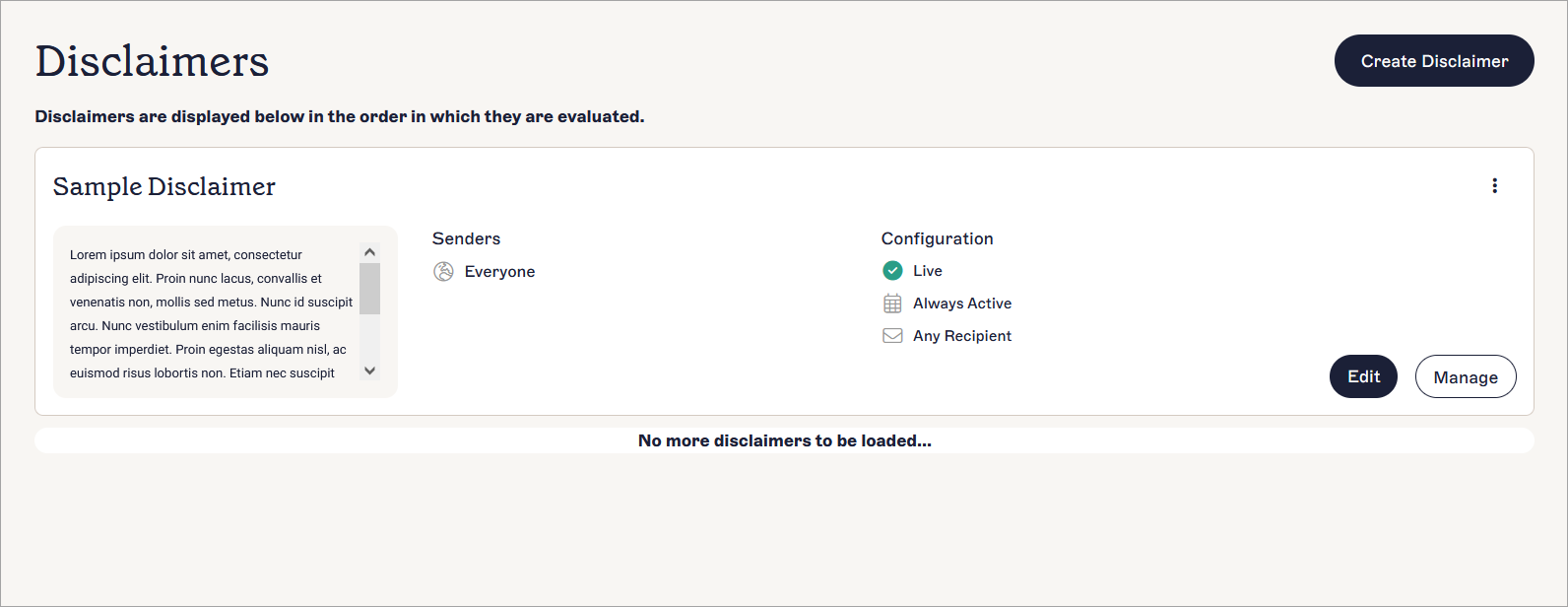 Native tools weren't built for the jurisdiction-specific version of this problem. Exchange transport rules and Google Workspace's own footer settings can each apply one static disclaimer, but neither offers rule-based targeting by department, region, or audience.
Exclaimer applies your organization's disclaimers server-side, before an email leaves your network. That's the same disclaimer, in the same wording, regardless of device or email client, no matter who's sending it.
Exclaimer built the first-ever email signature software in 2001 and has spent 25 years on exactly this problem. Centralized updates remove the manual work of chasing down every mailbox when the wording changes, and the platform scales the same way whether you're managing fifty accounts or fifty thousand.
Exclaimer's Disclaimers feature supports legally compliant emails. It doesn't replace your legal team's judgment on what the wording should say, and, like any audit-log-based platform, it can show what's configured to send rather than serve as a courtroom record of exactly what left a specific mailbox on a specific date. What it does reliably is remove the variable that causes most disclaimer problems: relying on each person to apply the right text, correctly, every time.
Take your compliance efforts to the next level with Exclaimer’s email signature management software.