



Dave is a marketing expert with 15 years experience in the tech and SaaS world. He specializes in educating IT and channel audiences, with a focus on security, privacy, compliance, and marketing technology. With a talent for storytelling and a deep understanding of the industry, Dave transforms complex IT topics into clear, engaging, and impactful narratives.
Email disclaimers in the EU: Key rules and guidance
TL;DR
- There’s no single EU law that requires a general email disclaimer, but several EU and national rules determine what company information must appear in business emails
- Requirements vary across member states, and many organizations rely on disclaimers to keep details like registration numbers and legal form consistent
- EU businesses also use disclaimers to clarify confidentiality, guide handling of sensitive information, and manage multilingual communication
- Each member state has its own rules for what needs to appear in business correspondence, making a standardized, automated approach essential
- Exclaimer helps organizations apply the correct disclaimer and company information across all users, languages, and regions without manual updates
Email plays a central role in how organizations across the European Union communicate with customers, partners, and internal teams. Because of this, many businesses include an email disclaimer to support clear communication, reduce risk, and meet the expectations set by local regulations.
The EU doesn’t operate under a single set of rules for email content. Instead, requirements can vary by member state, and organizations often rely on disclaimers to keep their communication consistent across borders. These notices help clarify how information should be handled and provide structure when teams operate in multiple languages or jurisdictions.
This guide outlines how email disclaimers are used across the EU, where legal requirements come into play, and what organizations should consider when creating a standard approach.
Are email disclaimers legally required in the EU?
There is no EU-wide law that requires organizations to include a standard email disclaimer. However, several EU directives and national regulations determine what information must appear in business communications, including email. These rules vary by member state and often apply to details such as a company’s legal name, registration number, and registered address.
Email disclaimers are commonly used across the EU because they support these country-specific requirements and help organizations maintain a consistent communication standard. They also provide clarity around confidentiality, internal policies, and how information should be handled—especially when messages may include personal or sensitive data.
In practice, disclaimers are not mandatory under EU law, but they are widely adopted because they offer structure, reduce ambiguity, and help align communication with local business regulations.
When EU organizations use email disclaimers
Organizations across the EU use email disclaimers for practical reasons that go beyond legal requirements. While the specifics vary by country, the overall purpose remains the same: keep communication clear, consistent, and aligned with local expectations.
Common reasons EU organizations rely on email disclaimers include:
1. Meeting country-specific business information rules
Several EU member states require companies to include details such as their legal name, registration number, or geographic address in business correspondence. Many organizations place this information in the email footer to keep it consistent across teams.
2. Operating across multiple jurisdictions
Businesses that work in more than one EU country use disclaimers to standardize communication. This helps teams avoid one-off variations that may not align with local requirements.
3. Managing multilingual communication
Because EU organizations often communicate in several languages, disclaimers help keep key information clear and consistent regardless of the recipient’s location.
4. Clarifying confidentiality and handling expectations
Disclaimers provide straightforward guidance on how the message should be treated—particularly when internal, sensitive, or personal data is involved.
5. Providing structure for regulated industries
Sectors such as finance, legal, healthcare, and government often use disclaimers as part of their communication standards, ensuring messages reflect the level of care expected in those environments.
While these disclaimers are not mandated at the EU level, they help organizations create predictable, structured communication across borders, languages, and regulatory environments.
EU laws that include the use of email disclaimers
As there’s no single legal standard across the European Union, the content of an email disclaimer depends on the member state, the type of information being shared, and the nature of the communication. Most EU organizations use disclaimers to keep required company information consistent, support local regulatory expectations, and guide recipients on how to handle sensitive or internal content.
Below are the key EU laws and directives that influence how businesses approach email disclaimers, along with examples tailored to each one.
The General Data Protection Regulation (EU) 2016/679
A disclaimer can help clarify handling expectations and reduce the risk of accidental disclosure, but it doesn't create GDPR compliance. The regulation requires appropriate technical and organizational measures.The General Data Protection Regulation (GDPR), sets the framework for how personal data is collected, processed, and stored across the EU. While GDPR does not require email disclaimers, many organizations use them to reinforce transparency and remind recipients that emails may contain personal information.
GDPR email disclaimer (example)
This email may contain personal or confidential information. If you are not the intended recipient, please delete the message and notify the sender. Do not share or forward its contents without permission.
Useful GDPR resources:
EU ePrivacy Directive (Directive 2002/58/EC)
Several EU organizations use email disclaimers to help reinforce that communications may contain confidential information and to provide recipients with clear instructions if the message is misdirected.Often referred to as the “Cookie Directive”, the ePrivacy Directive regulates privacy in electronic communications, including email. It does not mandate disclaimers, but it shapes how organizations handle electronic messaging, consent, and confidentiality.
ePrivacy email disclaimer (example)
This email and any attachments may contain confidential information relating to electronic communications. If you received this message in error, delete it and let the sender know. Please avoid distributing the contents without authorization.
EU Directive 2003/58/EC
The EU Directive 2003/58/EC, introduced in 2007, sets rules for business emails sent by companies within the European Union. This directive extended previous regulations for written correspondence, such as letters and faxes, to include emails and other forms of digital communication.
Under this law, all business emails must include a legally compliant EU email disclaimer. The email disclaimer must contain the following information:
company’s registered name
legal form
registered office address
registration number and registry
applicable court of registration
Company information disclosure disclaimer (example)
[Company Name] is registered in [Member State] under registration number [123456]. Registered office: [Full Address]. This message is intended only for the named recipient. If you received it in error, please delete it and notify the sender.
National business communication requirements
Beyond EU directives, many member states have their own rules for what information must appear in email communication. These laws do not mandate a traditional “disclaimer”, but they influence what organizations place in their email footer.
Examples of EU country-by-country information requirements
| Country | What must appear | Legal basis | Example footer line |
|---|---|---|---|
| Germany 🇩🇪 | - Registered company name and legal form (GmbH, AG, etc.) - Registered office location - Registration court and registration number - Managing directors/board members (for certain entities) | HGB §37a, GmbHG §35a, AktG §80 | [Company Name] GmbH, HRB 12345, Amtsgericht Berlin. Registered office: [Address]. |
| France 🇫🇷 | - Corporate name and legal form - RCS number and city of registration - Registered office address - Capital amount (for some entities) | Code de commerce Art. R.123-237 | [Company Name] SA, RCS Paris 123 456 789. Registered office: [Address]. |
| Ireland 🇮🇪 | - Full company name and suffix (Ltd, CLG, etc.) - Company registration number - Registered office address | Companies Act 2014 | [Company Name] Ltd, Reg. No. 123456. Registered office: [Address]. |
| Netherlands 🇳🇱 | - Registered company name - Registered office address - Trade register number (KvK) - VAT number (often included in practice) | Dutch Civil Code, Handelsregisterbesluit | [Company Name] B.V., KvK 12345678. Registered office: [Address]. |
| Belgium 🇧🇪 | - Company name and legal form - Registered office address - Enterprise number and “RPM/RPR” and relevant court - VAT number | Belgian Company Code | [Company Name] SRL/BV, BE 0123.456.789, RPM Bruxelles. Registered office: [Address]. |
| Spain 🇪🇸 | - Company name and legal form (S.L., S.A.) - Registered office - Trade Register data (volume, folio, sheet, etc.) - VAT number (NIF/CIF) | Código de Comercio; Law 34/2002 | [Company Name] S.L., NIF B12345678, Reg. Mercantil Madrid—T.12345, F.12, H.M-123456. |
| Italy 🇮🇹 | - Full company name and legal form - Registered office address - REA number - VAT number - Share capital (if applicable) | Italian Civil Code; DPR 633/1972 | [Company Name] S.r.l., P.IVA 12345678901, REA MI-1234567. Registered office: [Address]. |
| Denmark 🇩🇰 | - Company name - CVR number - Registered address - Legal form (A/S, ApS) | Danish Companies Act | [Company Name] A/S, CVR 12345678. Registered office: [Address]. |
| Sweden 🇸🇪 | - Company name and legal form (AB) - Registered office - Organization number | Swedish Companies Act | [Company Name] AB, Org.nr. 123456-7890. Registered office: [City]. |
| Austria 🇦🇹 | - Company name and legal form (GmbH, AG) - Registered office - Company register number and court - Managing directors (GmbH) | Unternehmensgesetzbuch (UGB) | [Company Name] GmbH, FN 123456a, Handelsgericht Wien. Registered office: [Address]. |
Freedom of information laws (country-specific)
Government bodies often use disclaimers to signal that messages may contain sensitive information or may be subject to disclosure under national transparency rules.Several EU member states operate national variations of freedom of information legislation (e.g., Ireland’s FOI Act 2014, France’s CADA, and others). These laws give the public access to certain government-held records, including email.
FOI-style email disclaimer
This email may contain information that could be subject to disclosure under applicable freedom of information laws. If you are not the intended recipient, delete the message and inform the sender. Do not distribute its contents without authorization.
Sector-specific regulations
Some industries across the EU use disclaimers to help support communication requirements, even though no law mandates them. Common sectors include:
Financial services (MiFID II, AMLD)
Healthcare (national health data regulations)
Legal services (professional privilege expectations)
Public-sector bodies (national administrative requirements)
Sector-specific disclaimer (example)
This message may contain information relevant to regulatory or internal requirements. If you are not the intended recipient, please delete it and notify the sender. Do not share or forward without authorization.
How Exclaimer supports EU email disclaimer requirements
EU organizations often deal with varying rules across member states, different languages, and large distributed teams. Managing country-specific company information and keeping email footers consistent can quickly become a challenge.
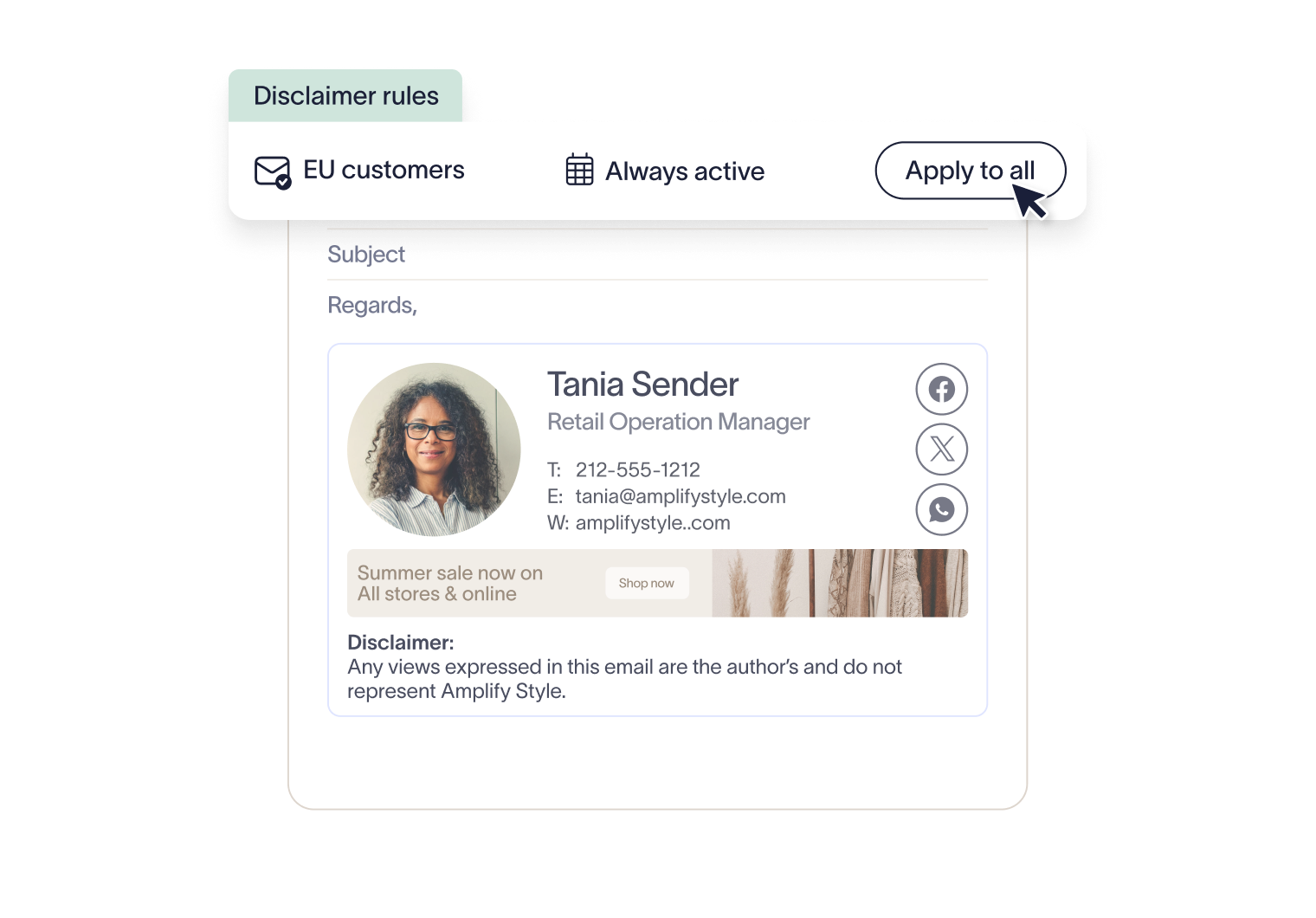 Exclaimer solves this by centralizing how disclaimers and company information are applied, ensuring every email sent from your organization includes the correct details for the right audience.
With Exclaimer, you can:
1. Meet country-specific disclosure requirements
EU member states require different details in business correspondence. Exclaimer lets you build and maintain variations for each country and ensures the right version is applied automatically.
2. Keep multilingual communication consistent
Many EU organizations operate in multiple languages. Exclaimer makes it easy to manage localized versions of disclaimers and company information, so every user sends email that matches the recipient’s language expectations.
3. Standardize information across teams and regions
Instead of relying on employees to update their email settings, Exclaimer applies approved wording, layouts, and required company details to every outgoing message. This reduces mistakes and prevents outdated or incomplete information from being sent externally.
4. Update legal or company information immediately
If regulations change or your organization undergoes updates, such as new registration details or a change in legal form, you can roll out the new information instantly to every user.
5. Maintain strong governance across borders
Exclaimer helps ensure that communication remains consistent, predictable, and aligned with internal policies. This is especially important when operating across multiple EU jurisdictions with different expectations for business correspondence.
Find out how Exclaimer can support your legal compliance and start a free trial today.