Naimh is a seasoned marketer of 12 years, including in SaaS and tech. She’s an expert at simplifying complex technology concepts, bridging the gap between IT and marketing. Naimh specializes in turning tech speak into actionable insights, helping marketers get the most out of their tools and technology.
B2B personalized marketing in practice: How to effectively reach your target accounts
Key takeaway
B2B personalized marketing tailors content, outreach, and offers to a specific account, role, or buying stage, using data your company already holds.
Personalization programs mature through four stages (crawl, walk, run, sprint) and work at three tiers (one-to-many, one-to-few, one-to-one).
Pipeline velocity, conversion rate, and deal size show more about personalization than clicks or open rates do.
Email signature banners are an owned channel. Exclaimer customers average a 4% click-through rate on email signature content.
Exclaimer's team built every one-to-one campaign by hand before it adopted automation, as Senior Digital Marketing Manager Ilana Trapeznikov explained in a 5 December 2024 webinar, How to master personalization in B2B marketing with Mutiny, a website personalization platform.
This article combines the takeaways from that 2024 session with those from Exclaimer's earlier 27 June 2023 webinar, Personalization: How to build engagement in an impersonal world, on building engagement in an impersonal world.
Most B2B marketing leaders call personalization essential
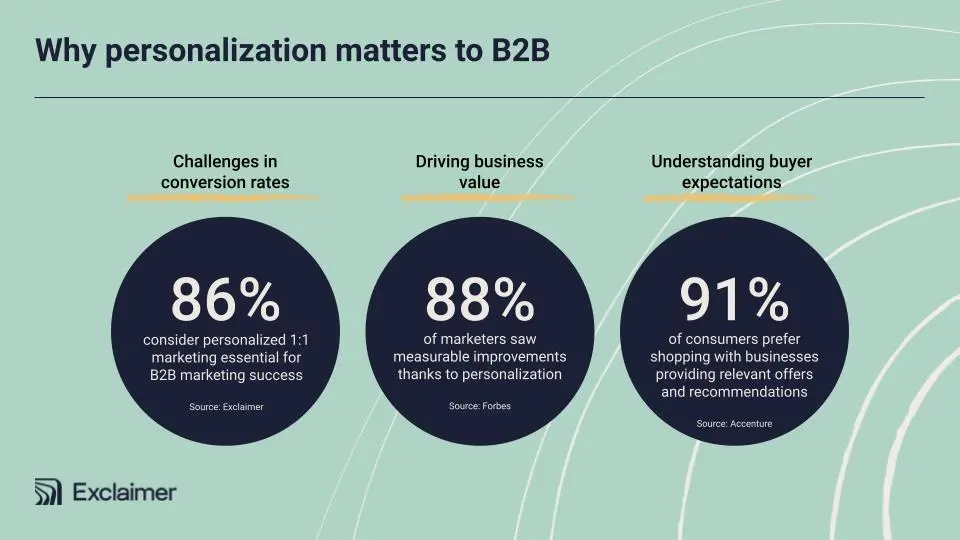
86% of B2B SaaS marketing leaders consider personalized one-to-one marketing essential to B2B marketing success, according to the 2024 FINITE survey of 120 global leaders that Exclaimer commissioned for its Future of Marketing Report. The same report states that 55% of marketers say it has become harder to reach customers than it was five years ago.
Consumers expect personalization too. McKinsey's research, published on 12 November 2021, found that 71% of consumers expect companies to deliver personalized interactions and 76% get frustrated when that does not happen. This is consumer data, not B2B buyer data.
Generic B2B websites lose buyers who arrive with a specific problem
According to the Exclaimer and Mutiny webinar, a generic website loses buyers because visitors leave unsure what the company does or how it can help them.
The webinar's answer was to use the first-party data marketers already hold, meaning information a company collects directly from its own website visitors, CRM records, and outreach campaigns, to give each visitor a clear, relevant page.
Privacy rules make personalization harder, so teams must update their data plans
Privacy concerns make targeting and personalization harder, according to Exclaimer's 2023 webinar. The same session said budgets have to keep up with growing media spend, so marketers must do more with less.
The webinar's advice was to invest in data and insights, which lets a team decide what content to serve specific customers and track what works. The webinar also said to review the tech stack for advertising measurement tools that comply with current privacy rules and to update the company's privacy playbook.
Personalization works best when teams beyond marketing own it
The 2023 Exclaimer webinar said customer engagement is a companywide opportunity, not a marketing issue measured only by Net Promoter Score (NPS). The webinar's reasoning was that every department must focus on customers, so the product and overall experience live up to the promises marketing makes.
In Exclaimer's recap of the 2024 webinar, Ilana Trapeznikov said the team brought together demand generation managers, digital teams, and content experts to build a shared understanding of personalization and its priorities.
Four steps for building a personalization program
Mutiny's published case study on Exclaimer lists four steps for building a personalization program.
Level set. The group agreed on what personalization means for Exclaimer and mapped every element the team could customize, from website copy and logos to social proof and calls to action.
Brainstorm. Team members first set business goals, then worked out who they could target and what would work best for each audience.
Map. The group built a matrix that matched audience segments to tactics, such as personalized CTA buttons or dynamic banners.
Prioritize. The team sorted initiatives into "Do Now," "Plan For," and "Backlog," judging each on available resources, potential impact, and technical feasibility.
Personalization works differently for new accounts, open deals, and existing customers
Personalization changes with the buying stage, and each stage needs different data. The Exclaimer and Mutiny webinar covered three.
Stage | Goal | Data to use | Typical tactics |
New accounts | Get noticed by a target account | Persona, company type, and other B2B customer data already collected | Personalized outbound emails and one-to-one microsites (small websites built for a single account) |
Open pipeline | Keep the deal moving | Pain points, needs, and goals gathered by the sales team | Tailored messaging, targeted content, and helpful demos |
Existing customers | Build the relationship and guide next steps | Data gathered about the customer since they signed | Upsell messages, personalized calls to action on the website, and relevant case studies |
According to the webinar, heavy personalization on a prospect's first website visit can come across as intrusive, so outbound channels are the safer place to start.
Personalization programs mature through four stages
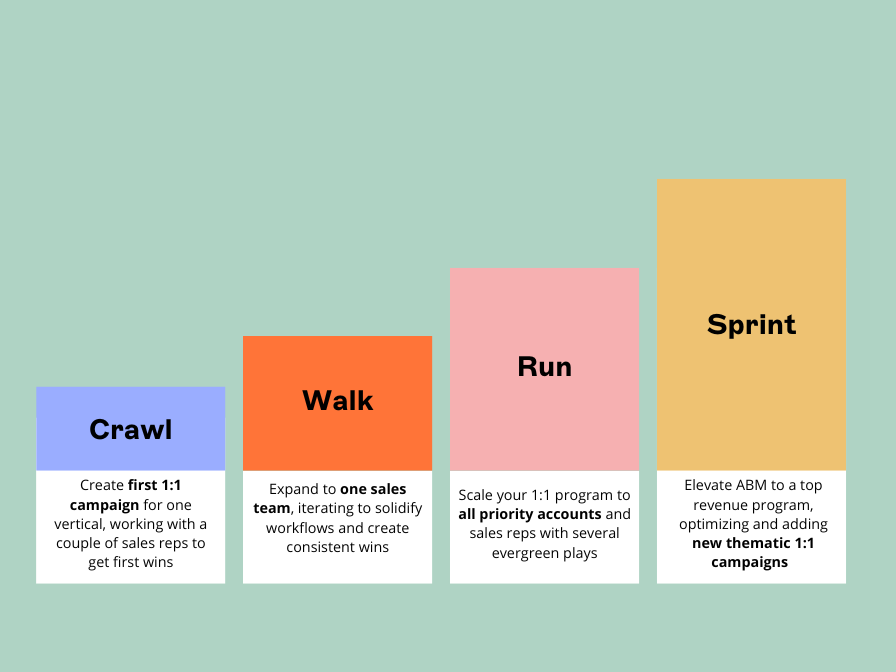
The crawl, walk, run, sprint framework helps a team assess how mature its personalization program is. The Exclaimer and Mutiny webinar adapted the framework from a model used to scale start-ups.
Stage | Focus | Signal or pitfall |
Crawl | Launch a first campaign, work with a few pilot sales reps, and test personalization approaches | Pitfall: Expecting immediate results, such as many booked meetings |
Walk | Expand from pilot reps to the whole sales team, codify playbooks, and streamline workflows | Signal: Consistent wins that the team shares to build momentum |
Run | Scale personalization across priority accounts with evergreen plays, meaning proven tactics that keep delivering results | Signal: Solid workflows and data that delivers consistent results |
Sprint | Optimize, run creative campaigns, and act on new industry opportunities | Signal: Account-based marketing (ABM) becomes a top revenue driver and personalization is part of the overall marketing strategy |
Exclaimer worked at three personalization tiers
Exclaimer's team worked at three tiers, according to Mutiny's published case study on Exclaimer. The tiers differ in how many accounts one piece of personalization serves.
The table gives the standard meaning of each tier. The definitions are general and are not quoted from the case study.
Tier | Accounts served by one piece of personalization |
One-to-many | A broad segment |
One-to-few | A small cluster of similar accounts |
One-to-one | A single named account |
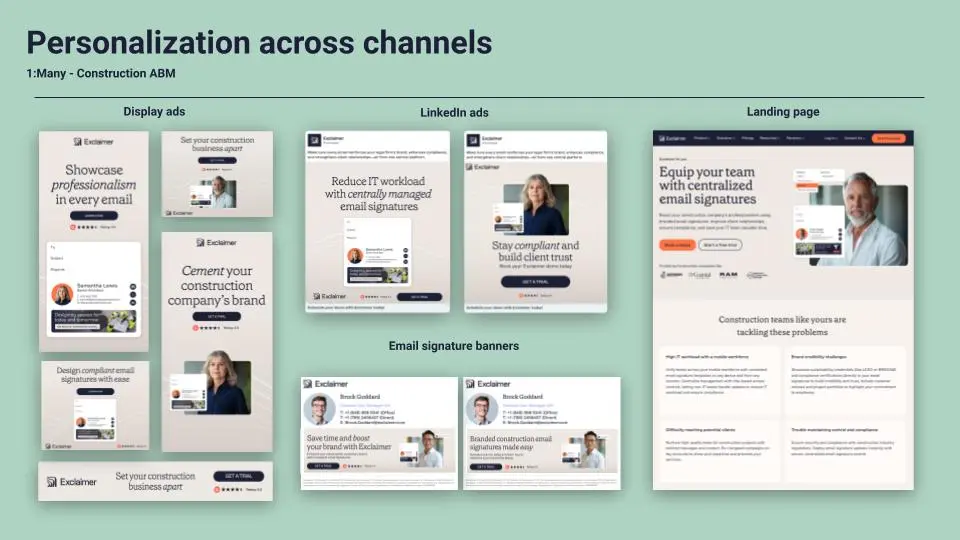
The case study lists one-to-many email signature banners among Exclaimer's tactics. The 5 December 2024 webinar showed how Mutiny builds custom microsites for targeted accounts, which is the one-to-one end of the scale.
Automation makes one-to-one campaigns easier to run, even with large datasets
Exclaimer replaced manual campaign building with automation platforms and frameworks, as Ilana Trapeznikov explained in the 5 December 2024 webinar.
According to the webinar, Exclaimer uses Mutiny, a website personalization platform, to build dynamic microsites and adjust website navigation by audience. The platform pulls current data from Exclaimer's customer relationship management (CRM) system and adjusts messaging, images, and calls to action by audience attribute, which makes one-to-one campaigns easier to execute, even with large datasets.
B2B personalization examples
The Exclaimer and Mutiny webinar showed three B2B personalization examples across the buyer journey.
Microsites for targeted accounts. Mutiny explained that its team builds custom microsites with company logos and client-specific examples.
Personalized email signature banners. Exclaimer showed how email signature banners can send target accounts to a specific microsite or landing page, so the experience stays connected from outreach to engagement.
Sales collaboration. Both Exclaimer and Mutiny stressed working closely with sales. Sales can use microsites or one-to-one ads during prospecting, and automated notifications tell the team when a prospect engages with key content.
Performance marketing plateaus, so brand content and a wider channel mix matter
Performance marketing eventually plateaus when optimization stops driving the desired business results, according to Exclaimer's 27 June 2023 webinar. Its answer was brand-building content with a clear point of view, plus a channel mix that never relies on one channel, because privacy rules and social media algorithms keep changing.
At the time, Exclaimer ran performance marketing on Google, LinkedIn, and Twitter (now X), alongside digital advertising and content syndication. Exclaimer was moving to a demand generation model built on a content engine of its brand, staff, community, and customer stories. The webinar reported promising early results and gave no figures.
Email signatures give B2B teams an owned channel for personalization
The email signature is an owned marketing channel, meaning a channel a company controls directly, and every email an employee sends can carry a banner in it. Exclaimer customers average a 4% click-through rate on email signature content, according to Exclaimer's blog post on maximizing marketing ROI with personalized email signatures.
Exclaimer's 2023 webinar agenda called business email an untapped opportunity for personalization and engagement. The write-up of that webinar said email signature templates let an organization promote its latest content, show its brand personality, and extend the reach of its marketing campaigns.
Exclaimer's Campaigns feature runs marketing banners in employee email signatures
Exclaimer's Campaigns feature runs marketing banners in employee email signatures. Marketing teams set start and end dates, choose who sees each campaign by sender or recipient, track clicks in Google Analytics with UTM parameters (tags added to a link so analytics tools can attribute clicks), and measure engagement from one dashboard.
According to Exclaimer's brand consistency page, Exclaimer applies approved email signature templates across every email, sender, and device from one central dashboard. Central control keeps what employees send consistent.
For campaign tactics, see Exclaimer's guide to email signature marketing dos and don'ts.
Pipeline velocity, conversion rate, and deal size show whether personalization works
Exclaimer's recap of the 5 December 2024 webinar advises measuring personalization by more than clicks or open rates, such as pipeline velocity, conversion rate, and deal size. Pipeline velocity is the speed at which deals move through the sales funnel.
Conversion rate is already the most common measure. In the 2024 FINITE survey of 120 global B2B SaaS marketing leaders, 78% measure personalization by conversion rate.
Measure | Share of leaders using it |
Conversion rate | 78% |
Customer retention | 46% |
Click-through rate | 38% |
At the 2024 webinar, Molly Bruckman outlined how Mutiny tracks microsite views to prioritize high-intent accounts, with real-time notifications so sales can act when interest peaks. Exclaimer tracks which email signature campaign tactics send the most visitors to personalized landing pages.
Mutiny reports that marketing and sales reached 100% of Exclaimer's ABM accounts
According to Mutiny's published case study on Exclaimer, marketing and sales both reached 100% of the accounts in Exclaimer's account-based marketing (ABM) program. The page gives no publication date or measurement period for its four reported results, and it does not say whether +4% is percentage points or relative lift.
Result | Figure reported by Mutiny |
Click-through rate on one-to-many email signature banners | +4% |
ABM accounts reached by both marketing and sales | 100% |
Consideration-stage accounts | +250% |
Decision-stage accounts | +67% |
The next stage of B2B personalization pairs AI-assisted content with regular testing
Mutiny plans to add more advanced AI to speed up personalized content creation, according to the 5 December 2024 Exclaimer and Mutiny webinar. Exclaimer plans to use more of its product features to personalize smaller touchpoints.
In the 2024 FINITE survey of 120 global B2B SaaS marketing leaders, 36% saw the potential of AI and machine learning to improve personalization and targeting. The webinar speakers said regular testing of messaging, formats, and delivery methods keeps campaigns effective as buyer preferences shift.
Start with one tier and one channel
Pick one tier and one owned channel, then expand as the workflows prove out. Email signature banners for a single account segment make a workable first test.
Exclaimer's email signature management platform works with Microsoft 365, Google Workspace, and Microsoft Exchange.
See how it supports ABM campaigns, then start a 14-day free trial or book an online demo.