



Why buying beats building: The smarter IT strategy
20 November 2025
0 min read
It’s easy to see why IT teams build their own tools. They offer control, customization, and the satisfaction of solving a problem your way. But what starts as a quick fix often turns into a long-term drain on time, budget, and people.
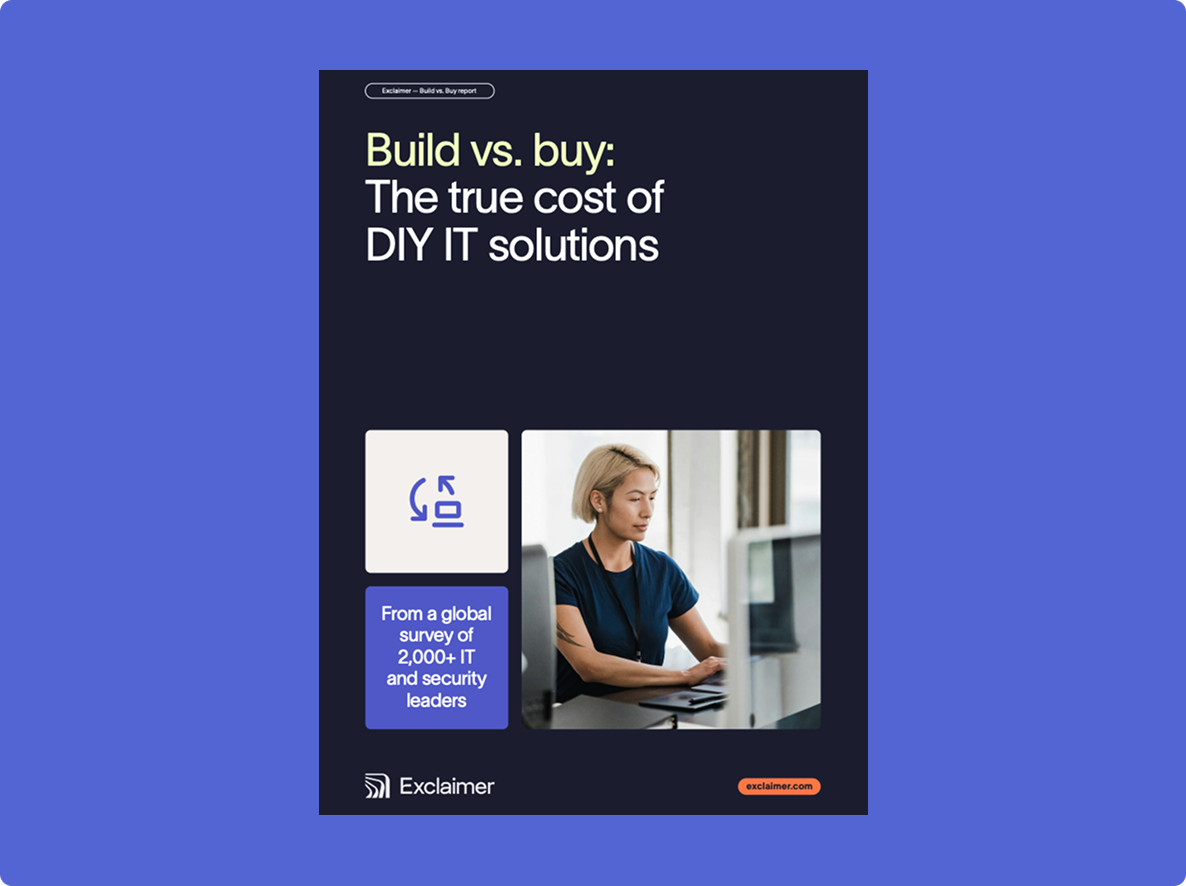
That’s the focus of Exclaimer’s latest research report, Build vs. buy: The true cost of DIY IT solutions. Based on insights from over 2,000 IT and security professionals across the U.S., UK, Germany, and Australia, the findings are clear: while building in-house might feel right, it’s rarely the most effective or scalable route.
Why build isn’t always better
Building in-house can feel like the smart choice. That is, until reality sets in. Custom tools look great on paper, but most fail to scale or deliver long-term value.
According to Exclaimer’s research, 44% of IT teams prefer to build their own tools. But 71% of those are eventually abandoned.
Abandonment is often a sign of fatigue rather than a sign of failure. Many of these tools are built with the best intentions but without the time, budget, or structure to maintain them. As priorities shift, internal builds fall behind and end up on the shelf.
So, what’s the better investment? Purpose-built solutions that deliver value without adding technical debt or draining internal resources.
The illusion of control
Building your own tool appeals to IT instincts. It offers control, customization, and compliance alignment. For some, it’s just more fun to create something from the ground up.
But every custom decision adds hidden complexity, more risk, and a mounting maintenance backlog.
90% of teams spend between 10–100 hours every month maintaining internal tools.
91% say this maintenance load “significantly” or “moderately” limits productivity and blocks strategic progress.
There’s also the issue of knowledge loss. When the person who built the system moves on, what’s left behind is often undocumented, fragile, and difficult to maintain. That makes future support harder, slower, and more expensive.
That’s not control. It’s constraint.
The hidden cost of in-house builds
DIY tools are never really “done.” As business needs evolve, so do the requirements. And it’s always IT who’s tasked with owning the maintenance.
74% of IT teams spend between $20,000 and $250,000 annually just to keep in-house tools running. Another 4% spend even more. Those costs often get absorbed into operational budgets, making ROI hard to measure and even harder to justify.
Budget creep becomes the norm. 46% of teams say in-house projects cost 1.6–2x more than planned, with an additional 16% spending more than double their original estimate. Fewer than 12% stay on budget.
By comparison, vendor solutions tell a different story. They often cost less and come with built-in support, security, and updates. They also avoid the “variance trap”—unpredictable costs and the creeping sprawl of technical debt that comes with every new feature request.
Then there’s uptime and reliability. 64% of IT professionals say they’ve experienced downtime or avoidable errors linked to in-house tools. That leads to financial and reputational risks that go far beyond being just a nuisance.
Why vendors scale better
Building a tool is one thing. Keeping it relevant, secure, and compliant year after year? That’s a full-time job that IT teams rarely have the bandwidth for. Vendor partners, on the other hand, are built for it.
Specialist vendors continuously invest in security certifications, platform integrations, and service-level guarantees. They maintain the infrastructure. They evolve with the platforms you depend on like Microsoft 365, Google Workspace, and Salesforce. And when APIs change or compliance rules tighten, vendors are already ahead of them. In-house teams simply can’t move at that pace.
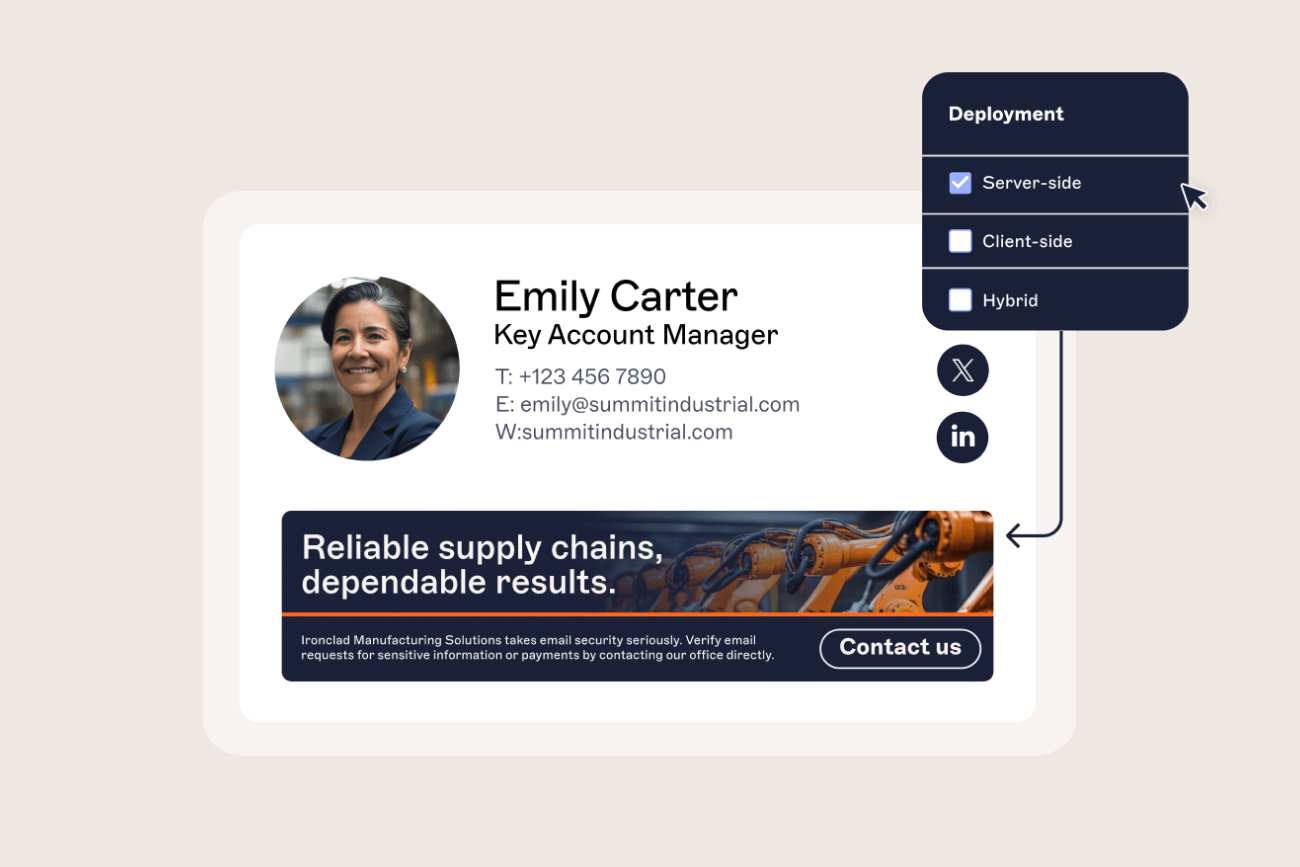
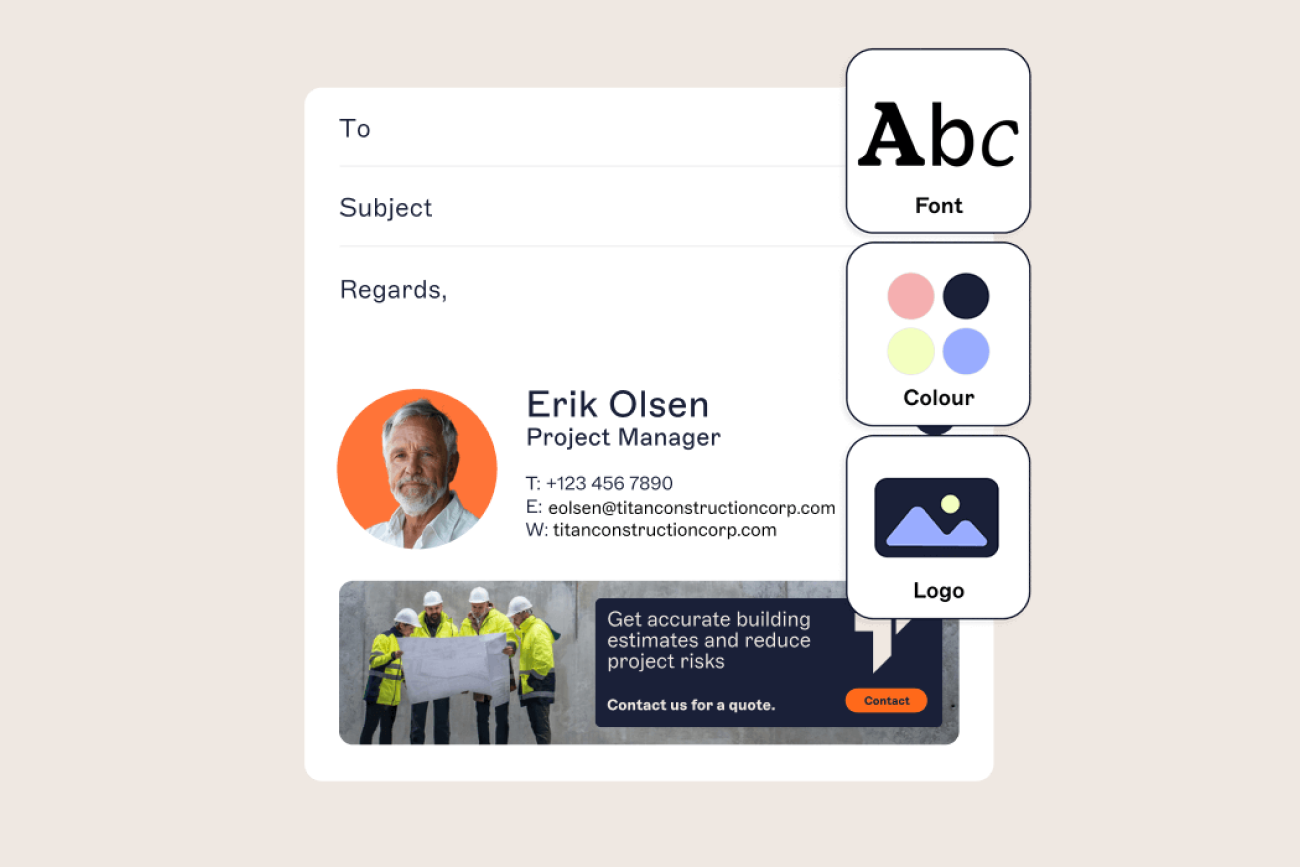
That’s what makes vendor solutions resilient. It’s why IT leaders rely on them for critical workflows like authentication, backups—and yes, even email signature management.
Our research highlights why:
30% of IT teams buy vendor solutions because they deploy faster
29% value access to specialist capabilities
28% choose vendors for around-the-clock reliability
26% want to reduce their internal security burden
These benefits compound over time. Vendor tools solve today’s problems while delivering value tomorrow.
The real opportunity cost
Every in-house workaround comes at a price. For most IT teams, that price is time—time lost to maintenance, patching, and chasing down bugs. Time not spent modernizing infrastructure or driving automation. Time that could be spent on work that actually moves the business forward.
CIOs want their teams focused on transformation, not tool upkeep. Yet 91% of IT leaders say maintaining internal tools directly limits their ability to deliver strategic work.
The longer teams cling to DIY tools, the more opportunities they miss.
From “build pride” to “buy performance”
Yes, building proves technical skill. But buying shows operational maturity.
Modern IT leaders know that speed, compliance, and reliability matter more than custom code. Buying is a strategic decision to reduce risk, accelerate delivery, and focus on work that drives transformation.
Vendor solutions eliminate repetitive work. They cut overhead, maintain compliance, and deliver ongoing support—things in-house builds rarely sustain.
In short: stop reinventing the wheel and start moving your business forward.