


The AI revolution: Empowering marketers to work smarter
26 July 2023
0 min read
The AI marketing revolution is well underway. It’s allowing businesses to engage audiences in more impactful ways, and for marketers to achieve more with less effort and spend.
Hosted by Ailsa Bates, Exclaimer’s Director of Content & Brand, hear from Megan Boshuyzen, Senior Email Developer at Sinch Email and Ottavio (Tav) Dattolo, Senior Global Demand Generation Manager at Drift as they discuss how AI can empower marketers to work smarter, improve efficiencies, and reduce costs.
The most common types of AI
AI is typically segmented into four distinct types:
Machine Learning (ML)
Machine Learning (ML), a subset of AI, enables computers to automatically learn from data and act with minimal human interaction.
For AI marketing, machine learning's data-driven insights enable more precise customer targeting, removing guesswork and allowing businesses to continually adapt to changing landscapes.
Generative AI
Generative AI allows users to rapidly create new content based on simple text-based prompts.
It uses AI foundation models that are trained on a broad set of unlabeled data that can be used for different tasks. Complex math and computing power are needed to create these trained models, but in essence, they’re prediction algorithms.
Natural Language Processing (NLP)
Natural Language Processing (NLP) refers to AI's capability to communicate in human language, also known as ‘language in’. Marketers can use NLP technology to analyze customer feedback and social media conversations.
By understanding the sentiment and key themes contained within, you gain insights into customer preferences and trends, allowing you to tailor your marketing strategies and improve product offerings.
Conversational AI
Conversational AI is what lets machines recognize and respond to speech and text inputs by merging natural language processing (NLP) with machine learning (ML). These conversational systems also improve over time, collecting and using information from each interaction to enhance their abilities.
Whether providing customer support or streamlining processes, conversational AI fosters engagement, accuracy, and efficiency.
7 ways marketers can use AI
Now that you understand the different types of AI technologies, let’s explore how marketers can use them to enhance their productivity and performance.
1. Social media listening
AI algorithms can rapidly analyze huge amounts of data, such as customer feedback and social media conversations.
Marketers can use these insights to figure out what customers like and dislike. They can also use this information to better tailor their marketing strategies and improve their products.
2. Content creation
Marketers can use AI tools to create written content, images, and videos in a few clicks. AI tools like ChatGPT streamline the time it takes to generate a first draft, allowing marketers to focus on editing and optimizing.
However, marketers should be careful not to rely on AI too much. It’s a useful tool, but humans still need to tell AI what to do, which insights to use, and what style to adopt.
3. Automation and personalization
AI algorithms analyze customer datasets in seconds, providing key insights that allow marketers to understand their customers in detail and automatically personalize their digital experiences.
For instance, AI can optimize email campaigns by adjusting subject lines, content, and sending times to match individual preferences. This increases the chance that prospects and customers will engage with marketing campaigns.
4. Chatbots and virtual assistants
Chatbots and virtual assistants allow businesses to interact with customers 24/7/365. Being constantly available to answer queries reduces friction in the buying process, enhancing the customer experience and increasing conversions.
What’s more, AI chatbots gather valuable data that helps businesses better understand customer needs, enhance products, and personalize communications. Marketers can leverage these insights to tailor their marketing campaigns and stay on top of changing customer trends.
5. Predictive analytics and forecasting
Predictive analytics involves using AI, data, and statistical techniques to analyze past data and predict future trends. For instance, marketers might analyze the impact of seasonality on product sales to determine when they should run special promotions on specific items.
6. Competitive intelligence
AI-powered competitive intelligence allows marketers to monitor both the market and their competitors. It gives them a competitive edge, ensuring they’re always in the know and well-positioned to respond to market changes.
For example, they can monitor competitors' job roles to detect if a competitor is in trouble, going through a takeover, or moving into a new industry. Or, they can track pricing changes to better understand their pricing strategies.
7. Big data and analytics
AI simplifies big data analytics by automating and enhancing tasks that would otherwise be labor-intensive and time-consuming, such as data preparation, data visualization, and predictive modeling.
It allows marketers to rapidly unearth actionable insights, adapting almost instantly to changing market trends.
Using AI and machine learning for automated marketing
AI now plays a critical role in automating marketing efforts. Consider email marketing, for example. AI can optimize various aspects of email campaigns, from subject lines and content personalization to the best times to send emails. It can even help you identify the most appropriate email signatures to use in business emails for different segments of your target audience.
By analyzing user behavior and engagement metrics, AI can predict what type of content a specific customer is most likely to engage with, when they're most likely to read an email, and even what kind of subject line might catch their attention.
It’s worth noting that automated marketing can also nurture customer relationships over the long term. It can guide customers along the buyer's journey, fostering engagement and building trust. This gentle rhythm of consistent, personalized interactions helps businesses create lasting relationships with their customers, leading to increased loyalty and lifetime value.
Automated marketing is not just about automating tasks: it's about using AI to understand customers better, meet their needs, and build long-term relationships.
Prepare for an AI-powered future
AI in marketing is more than a trend, it's a game-changer. Marketers who embrace AI will gain a competitive edge, boost their customer experiences, and increase their company’s bottom line.
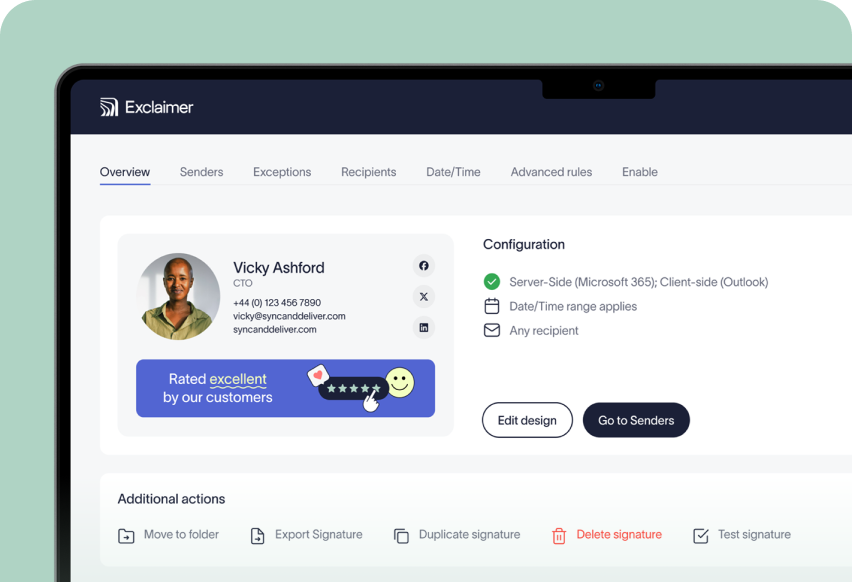
At the same time, it’s important to use channels you already own to better boost marketing engagement; channels like business emails. That’s why the best marketers combine AI with a comprehensive email signature strategy powered by Exclaimer.
Sign up for a free trial or book yourself an online demo to start turbo-boosting your email signatures.